
How to automate the grant research process with AI

For most companies, the search for grants starts the same way: opening a browser, typing something like "funding for innovation projects" or "R&D grants for SMEs", and getting into a maze of portals, PDFs and eligibility criteria that was clearly not designed to be read quickly. And because this tends to be the very first barrier in the funding journey, understanding how to automate the grant research has become one of the most effective ways to overcome it.


With AI, companies of all sizes can now approach grants more strategically, with less manual effort and considerably better visibility over what is actually available. In this article, we break down why grant research is so demanding, how AI is changing the way businesses find and assess funding opportunities, and what it actually looks like to automate this process.

What grants are available in Europe?


Finding relevant opportunities for your business means navigating a landscape that is far larger and more fragmented than most people expect.


At the European level alone, the funding ecosystem is vast. Horizon Europe, the EU's flagship research and innovation programme, is the most well-known entry point.

Just the European Innovation Council (EIC), considered one of the key pillars of Horizon Europe, has a dedicated budget of €1.4 billion for 2026, to support breakthrough and deep tech innovations across the full development lifecycle, from early-stage research all the way to market scale-up, including opportunities for startups and SMEs.


But there's more. Beyond Horizon Europe, programmes like Digital Europe target digitalisation and cybersecurity capabilities across the continent; LIFE supports environmental and climate initiatives; and the European Defence Fund backs research and development in defence technologies for companies working with innovation and security. Just to mention a few.


Then there are national and regional programmes, managed by each member state and often co-financed by EU funds, which can be equally relevant depending on where your company is based and what kind of project you're developing. Portugal, for example, has programmes like PRR (Plano de Recuperação e Resiliência) and PT2030, Spain has CDTI, and Germany has ZIM. Basically, each country has its own ecosystem of funding initiatives.


The result is a landscape that is genuinely rich in opportunity, but also very fragmented.

How to find grants for your company


For companies starting out, the most common entry points are the official sources. At the European level, the EU Funding & Tenders Portal aggregates all calls managed directly by the European Commission, and at the national level, each country has its own funding agencies.


But there is no single place where all opportunities are centralised, no unified search engine that filters by profile, and no alert system that tells you when something relevant has just opened.


The traditional approach to navigating all of this usually involves subscribing to newsletters from public agencies, following the websites of national funding bodies, working with consulting firms, relying on word of mouth from partners and industry networks, and, more recently, using general-purpose AI tools like ChatGPT to help with the search.


Each of these methods has its limitations. Newsletters are general and don't filter for your company's particular goals, websites can be outdated or incomplete, grant consultants are expensive and often focused on specific programmes, word of mouth can be unreliable and slow, and general AI tools have no proactive capability, which means opportunities can still slip through.


Monitoring all of these regularly, understanding which calls are relevant for your profile, and keeping track of deadlines across multiple programmes is a different challenge altogether — and one that most companies struggle to sustain over time.

For most companies, the search for grants starts the same way: opening a browser, typing something like "funding for innovation projects" or "R&D grants for SMEs", and getting into a maze of portals, PDFs and eligibility criteria that was clearly not designed to be read quickly. And because this tends to be the very first barrier in the funding journey, understanding how to automate the grant research has become one of the most effective ways to overcome it.


With AI, companies of all sizes can now approach grants more strategically, with less manual effort and considerably better visibility over what is actually available. In this article, we break down why grant research is so demanding, how AI is changing the way businesses find and assess funding opportunities, and what it actually looks like to automate this process.

What grants are available in Europe?


Finding relevant opportunities for your business means navigating a landscape that is far larger and more fragmented than most people expect.


At the European level alone, the funding ecosystem is vast. Horizon Europe, the EU's flagship research and innovation programme, is the most well-known entry point.


Just the European Innovation Council (EIC), considered one of the key pillars of Horizon Europe, has a dedicated budget of €1.4 billion for 2026, to support breakthrough and deep tech innovations across the full development lifecycle, from early-stage research all the way to market scale-up, including opportunities for startups and SMEs.


But there's more. Beyond Horizon Europe, programmes like Digital Europe target digitalisation and cybersecurity capabilities across the continent; LIFE supports environmental and climate initiatives; and the European Defence Fund backs research and development in defence technologies for companies working with innovation and security. Just to mention a few.


Then there are national and regional programmes, managed by each member state and often co-financed by EU funds, which can be equally relevant depending on where your company is based and what kind of project you're developing. Portugal, for example, has programmes like PRR (Plano de Recuperação e Resiliência) and PT2030, Spain has CDTI, and Germany has ZIM. Basically, each country has its own ecosystem of funding initiatives.

The result is a landscape that is genuinely rich in opportunity, but also very fragmented.

How to find grants for your company


For companies starting out, the most common entry points are the official sources. At the European level, the EU Funding & Tenders Portal aggregates all calls managed directly by the European Commission, and at the national level, each country has its own funding agencies.


But there is no single place where all opportunities are centralised, no unified search engine that filters by profile, and no alert system that tells you when something relevant has just opened.

The traditional approach to navigating all of this usually involves subscribing to newsletters from public agencies, following the websites of national funding bodies, working with consulting firms, relying on word of mouth from partners and industry networks, and, more recently, using general-purpose AI tools like ChatGPT to help with the search.


Each of these methods has its limitations. Newsletters are general and don't filter for your company's particular goals, websites can be outdated or incomplete, grant consultants are expensive and often focused on specific programmes, word of mouth can be unreliable and slow, and general AI tools have no proactive capability, which means opportunities can still slip through.


Monitoring all of these regularly, understanding which calls are relevant for your profile, and keeping track of deadlines across multiple programmes is a different challenge altogether — and one that most companies struggle to sustain over time.

For most companies, the search for grants starts the same way: opening a browser, typing something like "funding for innovation projects" or "R&D grants for SMEs", and getting into a maze of portals, PDFs and eligibility criteria that was clearly not designed to be read quickly. And because this tends to be the very first barrier in the funding journey, understanding how to automate the grant research has become one of the most effective ways to overcome it.


With AI, companies of all sizes can now approach grants more strategically, with less manual effort and considerably better visibility over what is actually available. In this article, we break down why grant research is so demanding, how AI is changing the way businesses find and assess funding opportunities, and what it actually looks like to automate this process.


What grants are available in Europe?


Finding relevant opportunities for your business means navigating a landscape that is far larger and more fragmented than most people expect.


At the European level alone, the funding ecosystem is vast. Horizon Europe, the EU's flagship research and innovation programme, is the most well-known entry point.

Just the European Innovation Council (EIC), considered one of the key pillars of Horizon Europe, has a dedicated budget of €1.4 billion for 2026, to support breakthrough and deep tech innovations across the full development lifecycle, from early-stage research all the way to market scale-up, including opportunities for startups and SMEs.


But there's more. Beyond Horizon Europe, programmes like Digital Europe target digitalisation and cybersecurity capabilities across the continent; LIFE supports environmental and climate initiatives; and the European Defence Fund backs research and development in defence technologies for companies working with innovation and security. Just to mention a few.


Then there are national and regional programmes, managed by each member state and often co-financed by EU funds, which can be equally relevant depending on where your company is based and what kind of project you're developing. Portugal, for example, has programmes like PRR (Plano de Recuperação e Resiliência) and PT2030, Spain has CDTI, and Germany has ZIM. Basically, each country has its own ecosystem of funding initiatives.


The result is a landscape that is genuinely rich in opportunity, but also very fragmented.

How to find grants for your company


For companies starting out, the most common entry points are the official sources. At the European level, the EU Funding & Tenders Portal aggregates all calls managed directly by the European Commission, and at the national level, each country has its own funding agencies.


But there is no single place where all opportunities are centralised, no unified search engine that filters by profile, and no alert system that tells you when something relevant has just opened.


The traditional approach to navigating all of this usually involves subscribing to newsletters from public agencies, following the websites of national funding bodies, working with consulting firms, relying on word of mouth from partners and industry networks, and, more recently, using general-purpose AI tools like ChatGPT to help with the search.

Each of these methods has its limitations. Newsletters are general and don't filter for your company's particular goals, websites can be outdated or incomplete, grant consultants are expensive and often focused on specific programmes, word of mouth can be unreliable and slow, and general AI tools have no proactive capability, which means opportunities can still slip through.


Monitoring all of these regularly, understanding which calls are relevant for your profile, and keeping track of deadlines across multiple programmes is a different challenge altogether — and one that most companies struggle to sustain over time.

For most companies, the search for grants starts the same way: opening a browser, typing something like "funding for innovation projects" or "R&D grants for SMEs", and getting into a maze of portals, PDFs and eligibility criteria that was clearly not designed to be read quickly. And because this tends to be the very first barrier in the funding journey, understanding how to automate the grant research has become one of the most effective ways to overcome it.


With AI, companies of all sizes can now approach grants more strategically, with less manual effort and considerably better visibility over what is actually available. In this article, we break down why grant research is so demanding, how AI is changing the way businesses find and assess funding opportunities, and what it actually looks like to automate this process.

What grants are available in Europe?


Finding relevant opportunities for your business means navigating a landscape that is far larger and more fragmented than most people expect.


At the European level alone, the funding ecosystem is vast. Horizon Europe, the EU's flagship research and innovation programme, is the most well-known entry point.


Just the European Innovation Council (EIC), considered one of the key pillars of Horizon Europe, has a dedicated budget of €1.4 billion for 2026, to support breakthrough and deep tech innovations across the full development lifecycle, from early-stage research all the way to market scale-up, including opportunities for startups and SMEs.


But there's more. Beyond Horizon Europe, programmes like Digital Europe target digitalisation and cybersecurity capabilities across the continent; LIFE supports environmental and climate initiatives; and the European Defence Fund backs research and development in defence technologies for companies working with innovation and security. Just to mention a few.


Then there are national and regional programmes, managed by each member state and often co-financed by EU funds, which can be equally relevant depending on where your company is based and what kind of project you're developing. Portugal, for example, has programmes like PRR (Plano de Recuperação e Resiliência) and PT2030, Spain has CDTI, and Germany has ZIM. Basically, each country has its own ecosystem of funding initiatives.

The result is a landscape that is genuinely rich in opportunity, but also very fragmented.


How to find grants for your company

For companies starting out, the most common entry points are the official sources. At the European level, the EU Funding & Tenders Portal aggregates all calls managed directly by the European Commission, and at the national level, each country has its own funding agencies.


But there is no single place where all opportunities are centralised, no unified search engine that filters by profile, and no alert system that tells you when something relevant has just opened.


The traditional approach to navigating all of this usually involves subscribing to newsletters from public agencies, following the websites of national funding bodies, working with consulting firms, relying on word of mouth from partners and industry networks, and, more recently, using general-purpose AI tools like ChatGPT to help with the search.


Each of these methods has its limitations. Newsletters are general and don't filter for your company's particular goals, websites can be outdated or incomplete, grant consultants are expensive and often focused on specific programmes, word of mouth can be unreliable and slow, and general AI tools have no proactive capability, which means opportunities can still slip through.


Monitoring all of these regularly, understanding which calls are relevant for your profile, and keeping track of deadlines across multiple programmes is a different challenge altogether — and one that most companies struggle to sustain over time.

For most companies, the search for grants starts the same way: opening a browser, typing something like "funding for innovation projects" or "R&D grants for SMEs", and getting into a maze of portals, PDFs and eligibility criteria that was clearly not designed to be read quickly. And because this tends to be the very first barrier in the funding journey, understanding how to automate the grant research has become one of the most effective ways to overcome it.


With AI, companies of all sizes can now approach grants more strategically, with less manual effort and considerably better visibility over what is actually available. In this article, we break down why grant research is so demanding, how AI is changing the way businesses find and assess funding opportunities, and what it actually looks like to automate this process.

What grants are available in Europe?


Finding relevant opportunities for your business means navigating a landscape that is far larger and more fragmented than most people expect.

At the European level alone, the funding ecosystem is vast. Horizon Europe, the EU's flagship research and innovation programme, is the most well-known entry point.


Just the European Innovation Council (EIC), considered one of the key pillars of Horizon Europe, has a dedicated budget of €1.4 billion for 2026, to support breakthrough and deep tech innovations across the full development lifecycle, from early-stage research all the way to market scale-up, including opportunities for startups and SMEs.


But there's more. Beyond Horizon Europe, programmes like Digital Europe target digitalisation and cybersecurity capabilities across the continent; LIFE supports environmental and climate initiatives; and the European Defence Fund backs research and development in defence technologies for companies working with innovation and security. Just to mention a few.


Then there are national and regional programmes, managed by each member state and often co-financed by EU funds, which can be equally relevant depending on where your company is based and what kind of project you're developing. Portugal, for example, has programmes like PRR (Plano de Recuperação e Resiliência) and PT2030, Spain has CDTI, and Germany has ZIM. Basically, each country has its own ecosystem of funding initiatives.


The result is a landscape that is genuinely rich in opportunity, but also very fragmented.

How to find grants for your company


For companies starting out, the most common entry points are the official sources. At the European level, the EU Funding & Tenders Portal aggregates all calls managed directly by the European Commission, and at the national level, each country has its own funding agencies.


But there is no single place where all opportunities are centralised, no unified search engine that filters by profile, and no alert system that tells you when something relevant has just opened.


The traditional approach to navigating all of this usually involves subscribing to newsletters from public agencies, following the websites of national funding bodies, working with consulting firms, relying on word of mouth from partners and industry networks, and, more recently, using general-purpose AI tools like ChatGPT to help with the search.


Each of these methods has its limitations. Newsletters are general and don't filter for your company's particular goals, websites can be outdated or incomplete, grant consultants are expensive and often focused on specific programmes, word of mouth can be unreliable and slow, and general AI tools have no proactive capability, which means opportunities can still slip through.


Monitoring all of these regularly, understanding which calls are relevant for your profile, and keeping track of deadlines across multiple programmes is a different challenge altogether — and one that most companies struggle to sustain over time.

Why is grant research so hard to do manually?


The scale of the European funding landscape is one of the first things that surprises companies when they start looking seriously. On the EU Funding & Tenders Portal, 635 opportunities have opened since January 2026. And as far as national and regional programmes go, Portugal 2030, for example, has 220 calls scheduled for this year alone.


The practical consequence is that most companies operate with a fragmented and incomplete picture of what's available. They follow a handful of sources, rely on consultants or industry contacts to flag opportunities, and inevitably miss calls that were genuinely relevant.


For most teams, keeping track of all the available grants is simply not possible. A call that opens today may have a deadline in six weeks. Managing to understand the eligibility criteria buried in 100-page work programmes, decide whether this call is actually a match with your company, gather all the necessary documentation, and still figure out the required structure for the proposal can become a mission on its own, even with external partners.

The problem looks different depending on your stage


Grant research does not look the same for every company. The challenges shift considerably depending on size, stage, and internal capacity.


For startups and SMEs, the challenge is straightforward: there are simply no resources to do it, human or money-wise. The team is focused on building the product, managing operations, and growing the business. Looking for grants is something that usually happens reactively, when someone happens to hear about an opportunity.


Without a structured process or the internal expertise to evaluate calls properly, many small companies either apply for grants they're not eligible for, waste time on applications that were never competitive, or simply don't apply at all because the process feels too complex to take on without external support.


For these companies, the dependency on human grant consultants is also costly. Hiring someone to identify and manage opportunities adds a layer of expense they simply can’t afford at this stage, and it also removes control from the team. The consultant's knowledge of the company's projects and objectives is always limited compared to what the founders and the rest of the team know.


For larger companies with multiple active projects, the challenge takes a different shape. Finding grants may not be their main concern, since many already have a defined roadmap and established programmes they follow. The real gap at the research stage is in proactivity: expanding the grant portfolio beyond the familiar, identifying opportunities that weren't on the radar, and making sure the company is capturing the full range of funding available for its projects.


Both scenarios point to the same underlying issue: grant research, as a manual process, doesn't scale. It requires too much time, specialised knowledge, and coordination to be done well, even with dedicated resources.

project.

How to automate grant research using AI


Before we dive deeper into this topic, one thing should be clear: AI does not replace human judgment in grant research. What it does is remove the bottlenecks that make the manual process so slow and inconsistent.


Understanding how to automate grant research starts with recognising what makes the manual process so constrained. For example, when a human researcher looks for grants, they can realistically monitor a handful of sources on a regular basis, read through a limited number of documents, and evaluate opportunities against criteria they hold in memory. The process demands time and attention. 


But, with AI, this process can operate differently. The AI agent can continuously scan hundreds of sources, extract structured information from long and complex documents, and cross-reference eligibility criteria against a company's profile. All that autonomously. 


Not all AI tools, however, work the same way in this context. General-purpose tools like ChatGPT and Claude can help with writing and summarising, but they have no access to live grant databases, no ability to check eligibility in real time, and no knowledge of a company's profile or ongoing projects. 


They also have no proactive monitoring capability. Generic LLMs only search when prompted, which means a relevant call can open and close without anyone ever knowing it existed. On top of that, getting more accurate results would require sharing sensitive company documents, which can be concerning for data security and compliance.


That’s why using a purpose-built AI agent to automate the grant research process can have an even bigger impact. It operates with all of this context already built in, and monitors the funding landscape continuously, without needing to be asked.


Instead of discovering opportunities reactively, weeks after they opened, or only when a consultant flags them, companies can have their own AI agent that finds relevant calls as soon as they are published, with enough time to prepare a competitive application. Rather than spending hours reading grant documentation just to determine whether a call is worth pursuing, teams can access a structured summary of everything they need to make that decision quickly.


Basically, the AI covers all the heavy-lifting: monitoring open calls across multiple sources, extracting and synthesising key information from complex documents, pre-screening opportunities for eligibility, matching projects to specific calls, tracking deadlines, and generating first drafts of proposals based on project data and call criteria.


That said, human involvement still matters. Deciding which opportunities to prioritise, understanding the broader context of a funding programme, making the final call on how to position your idea, and building relationships with consortium partners are steps that really benefit from human experience and strategic thinking, and that is where the team's energy is best spent.


How AI finds and matches grant opportunities to your profile

When we think about how to automate the grant research process, the matching quality of an opportunity comes down to one factor: how well the AI actually knows the company it is working with. That’s why we can say that finding is not even the first step of the journey; it’s the onboarding.

And that can look very different depending on the tool you choose to use. As we mentioned before, generic LLMs, like ChatGPT and Claude, depend entirely on what you want to share. They are not built specifically for funding applications; therefore, they don’t really know what information or documents can be relevant to kick off the process. 

Specialized platforms, on the other hand, bring a pre-determined set of data they might require to help automate the grant research. In Granter's AI Grant Consultant, that process goes far beyond basic company information.​


After a detailed onboarding with our account management team, companies have their own AI agent set up to start their journey. Based on the information shared, the AI agent works to understand the company's structure, legal status, and size; its strategic objectives and innovation roadmap; the types of projects it has developed or is planning to develop; and the outcomes it is trying to achieve through funding. It also reads existing documents, such as previous grant applications, project descriptions, technical reports, pitch decks, so that the matching it produces is grounded in real, specific information rather than generic company categories.


Once that profile is ready to go, the AI agent continuously scans the official portals and identifies opportunities with a genuine fit. This is not a keyword search. The agent evaluates calls against the full company profile, looking for alignment across multiple dimensions to give the business an inside look at what’s available for them out there. 


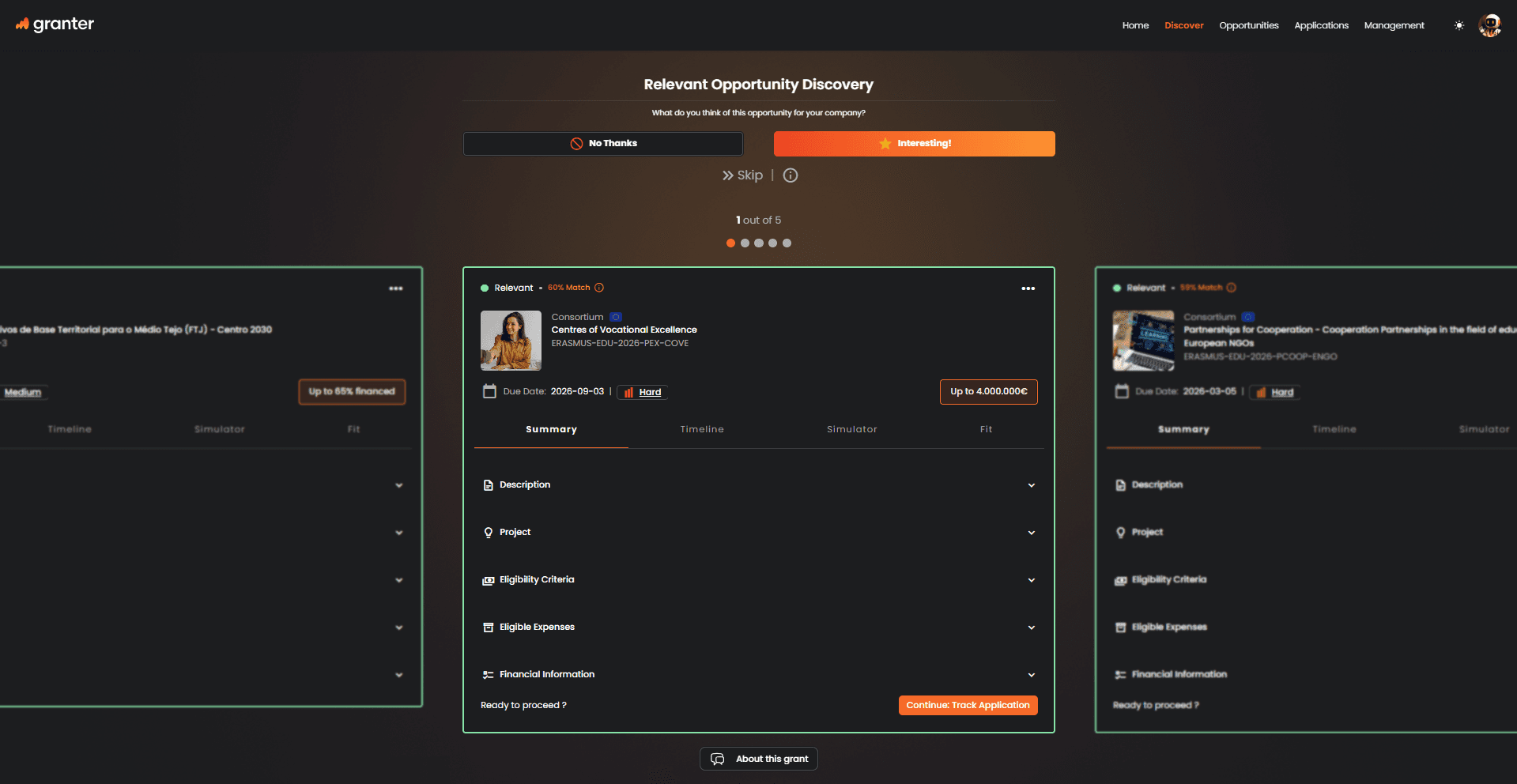
The results appear in the Discover tab, where users can review new opportunities as they are identified. Each one is presented not as a raw document link, but as a structured card with all the information needed to make an assessment without opening a single external PDF. 


The card includes a summary of what the call is funding, the types of projects and activities that are eligible, what expenses can be covered, the evaluation criteria, relevant deadlines, and a funding simulation that estimates the value the company could receive based on the call's parameters.


The card also shows which projects already registered in the platform could be relevant for that specific call, creating a direct link between the company's pipeline and the funding landscape, and making it easy to see not just what is available, but what is actionable right now.


This changes the relationship between businesses and the grant ecosystem in a meaningful way. For most companies, automating the grant research process is not just about expanding their existing strategy; it is about having a clear picture for the first time. Many simply do not know where to start, which programmes exist, or what they would actually be eligible for.


AI is here to change that. It gives companies a structured, up-to-date view of what is available for their profile, removing the guesswork and making it possible to approach grants with confidence.
What are the benefits of automating the grant search?


The most obvious benefit of automating the grant research process is time. As mentioned before, reading through complex documentation, eligibility criteria, and tracking what's open and when it closes are tasks that can consume dozens of hours per application cycle. Hours that most teams don't have to spare. 


But that’s actually not the most important benefit companies can take from AI-driven support. The most relevant one is knowing what funding opportunities exist in the first place. For companies that have never engaged with grants before, automation is first and foremost a discovery tool, a way to find out what is available, and whether their projects could qualify. 


For those already familiar with the landscape, it goes further, providing the visibility needed to capture opportunities they would otherwise miss. Most companies that rely on manual research are operating with an incomplete picture of what's available to them. They find some grants, apply for some of them, and wait for the next cycle. 

What they don't see is the much larger set of opportunities they're missing. Calls that were relevant but discovered too late, programmes they didn't know existed, funding instruments designed for exactly their type of project that never made it onto their radar.


Automating the grant research doesn't just make this step faster. It makes it more complete. The coverage is broader, the monitoring is continuous, and the filtering is more precise, which means the opportunities can be really relevant, not just the ones that happened to show up in a newsletter.


There's also a strategic dimension that often goes underappreciated. When a company has regular, structured visibility over the funding landscape, grants stop being something you apply for when you need money and start being something you build a strategy around. Knowing which programmes are opening, what themes are being prioritised, and what types of projects are being funded allows teams to plan their roadmap with that context in mind and design projects where fundability is part of the criteria. 


This shift from reactive to proactive is one of the most underrated outcomes of grant research automation. It doesn't just improve the efficiency of the application process; it changes how companies think about public funding.

Finally, there's less dependency on external consultants and team overload. For many businesses, the only way to access the grant ecosystem is through a consultant who manages the research and application process on their behalf. What can be expensive and also adds a layer of coordination that slows everything down. 


When the research process is automated, companies can manage their own funding pipeline with the information they need, without depending on external decisions or losing control over their own strategy.


Why automated eligibility assessment changes everything


Imagine going through the entire application process only to be rejected because of the eligibility criteria. And if that 's not frustrating enough, there’s still all the time and resources (sometimes financial) wasted to get the proposal done. No doubt this is one of the most common problems in the traditional process.


AI changes this from the very first step. Instead of going through a hundred-page document to find what matters, the team gets a clear, structured summary of the eligibility criteria, making a first assessment of the opportunity without the long hours of reading.


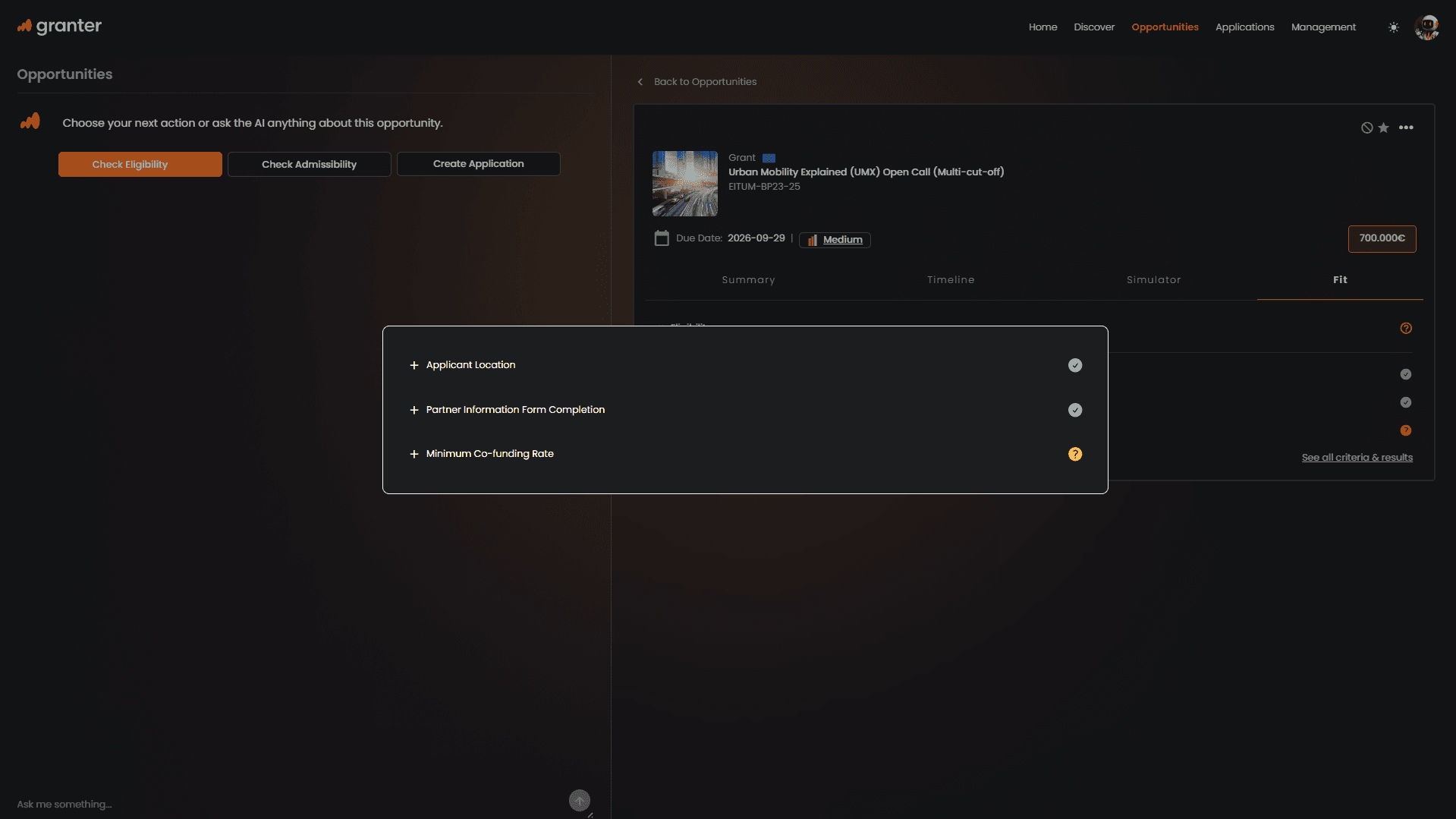
And with a specialised platform like AI Grant Consultant, the process goes further. The AI agent actively checks the company's eligibility against the call's criteria. If it needs more context, about the company's structure, a specific project, or an activity that falls into a grey area, it asks. The result is a detailed eligibility assessment that covers each criterion individually, explains what was evaluated, and references the specific information about the company used to reach that conclusion.


Right from the start, companies know exactly where it stands, and can decide with confidence whether to move forward with an application or redirect that energy toward opportunities with a stronger fit. Having clear feedback before a single word of the proposal is written really changes the dynamic, giving teams more confidence in this early step of the process.


What are the benefits of automating the grant search?


The most obvious benefit of automating the grant research process is time. As mentioned before, reading through complex documentation, eligibility criteria, and tracking what's open and when it closes are tasks that can consume dozens of hours per application cycle. Hours that most teams don't have to spare. 


But that’s actually not the most important benefit companies can take from AI-driven support. The most relevant one is knowing what funding opportunities exist in the first place. For companies that have never engaged with grants before, automation is first and foremost a discovery tool, a way to find out what is available, and whether their projects could qualify. 


For those already familiar with the landscape, it goes further, providing the visibility needed to capture opportunities they would otherwise miss. Most companies that rely on manual research are operating with an incomplete picture of what's available to them. They find some grants, apply for some of them, and wait for the next cycle. 

What they don't see is the much larger set of opportunities they're missing. Calls that were relevant but discovered too late, programmes they didn't know existed, funding instruments designed for exactly their type of project that never made it onto their radar.


Automating the grant research doesn't just make this step faster. It makes it more complete. The coverage is broader, the monitoring is continuous, and the filtering is more precise, which means the opportunities can be really relevant, not just the ones that happened to show up in a newsletter.


There's also a strategic dimension that often goes underappreciated. When a company has regular, structured visibility over the funding landscape, grants stop being something you apply for when you need money and start being something you build a strategy around. Knowing which programmes are opening, what themes are being prioritised, and what types of projects are being funded allows teams to plan their roadmap with that context in mind and design projects where fundability is part of the criteria. 


This shift from reactive to proactive is one of the most underrated outcomes of grant research automation. It doesn't just improve the efficiency of the application process; it changes how companies think about public funding.

Finally, there's less dependency on external consultants and team overload. For many businesses, the only way to access the grant ecosystem is through a consultant who manages the research and application process on their behalf. What can be expensive and also adds a layer of coordination that slows everything down. 


When the research process is automated, companies can manage their own funding pipeline with the information they need, without depending on external decisions or losing control over their own strategy.


Why automated eligibility assessment changes everything


Imagine going through the entire application process only to be rejected because of the eligibility criteria. And if that 's not frustrating enough, there’s still all the time and resources (sometimes financial) wasted to get the proposal done. No doubt this is one of the most common problems in the traditional process.


AI changes this from the very first step. Instead of going through a hundred-page document to find what matters, the team gets a clear, structured summary of the eligibility criteria, making a first assessment of the opportunity without the long hours of reading.


And with a specialised platform like AI Grant Consultant, the process goes further. The AI agent actively checks the company's eligibility against the call's criteria. If it needs more context, about the company's structure, a specific project, or an activity that falls into a grey area, it asks. The result is a detailed eligibility assessment that covers each criterion individually, explains what was evaluated, and references the specific information about the company used to reach that conclusion.


Right from the start, companies know exactly where it stands, and can decide with confidence whether to move forward with an application or redirect that energy toward opportunities with a stronger fit. Having clear feedback before a single word of the proposal is written really changes the dynamic, giving teams more confidence in this early step of the process.


Grant automation doesn't stop at discovery


Knowing how to automate the grant research process to find the right opportunity is just the first step. Once a relevant call is identified and eligibility is confirmed, the next challenge is preparing a competitive proposal. And that is where many businesses get lost.


Writing an application is time-consuming and technically demanding. Each call has its own structure, requirements and expected language. Getting it right requires a deep understanding of both the funding programme's priorities and the company's own projects and objectives. 


Just like in discovery, AI can also handle a significant part of grant writing. Using the company profile, project data, and the specific requirements of the call, the agent generates a first draft that is already aligned with the evaluation criteria, giving the team a solid starting point rather than a blank page. Of course, the human touch is still necessary for the strategy, narrative, and final review, but the volume of work that needs to be done from scratch is considerably reduced.


The automation doesn't stop there. Once a proposal is submitted and a grant is approved, a different and often more demanding phase begins. The company enters into a formal agreement, with obligations stretching across the entire duration of the project. Progress reports, milestone tracking, and payment requests are just a few to mention. For companies managing multiple funded projects in parallel, coordinating with consortium partners and sometimes with external consultants, keeping on top of all of this manually is a real operational risk.


AI can automate a significant portion of this administrative load. Reports can be automatically generated from structured templates rather than written from scratch, deadline alerts ensure that milestones are never missed, and the communication between stakeholders can be centralized and streamlined. 


This is where end-to-end automation makes a real difference. An AI agent that supports the full grant lifecycle (from discovery to post-approval management) brings speed and precision to every stage of the process, removing the friction that typically builds up when teams switch between tools, brief external partners, or pick up where someone else left off.


The European funding landscape is vast, competitive, and constantly evolving. Keeping up with it manually is a challenge that most teams simply cannot sustain anymore. Using AI for automation makes it possible to stay on top of that landscape continuously, act on the right opportunities at the right time, and approach public funding with the clarity and confidence it deserves.

Grant automation doesn't stop at discovery


Knowing how to automate the grant research process to find the right opportunity is just the first step. Once a relevant call is identified and eligibility is confirmed, the next challenge is preparing a competitive proposal. And that is where many businesses get lost.


Writing an application is time-consuming and technically demanding. Each call has its own structure, requirements and expected language. Getting it right requires a deep understanding of both the funding programme's priorities and the company's own projects and objectives. 


Just like in discovery, AI can also handle a significant part of grant writing. Using the company profile, project data, and the specific requirements of the call, the agent generates a first draft that is already aligned with the evaluation criteria, giving the team a solid starting point rather than a blank page. Of course, the human touch is still necessary for the strategy, narrative, and final review, but the volume of work that needs to be done from scratch is considerably reduced.


The automation doesn't stop there. Once a proposal is submitted and a grant is approved, a different and often more demanding phase begins. The company enters into a formal agreement, with obligations stretching across the entire duration of the project. Progress reports, milestone tracking, and payment requests are just a few to mention. For companies managing multiple funded projects in parallel, coordinating with consortium partners and sometimes with external consultants, keeping on top of all of this manually is a real operational risk.


AI can automate a significant portion of this administrative load. Reports can be automatically generated from structured templates rather than written from scratch, deadline alerts ensure that milestones are never missed, and the communication between stakeholders can be centralized and streamlined. 


This is where end-to-end automation makes a real difference. An AI agent that supports the full grant lifecycle (from discovery to post-approval management) brings speed and precision to every stage of the process, removing the friction that typically builds up when teams switch between tools, brief external partners, or pick up where someone else left off.


The European funding landscape is vast, competitive, and constantly evolving. Keeping up with it manually is a challenge that most teams simply cannot sustain anymore. Using AI for automation makes it possible to stay on top of that landscape continuously, act on the right opportunities at the right time, and approach public funding with the clarity and confidence it deserves.

We’re building something powerful. Want in?

Join the waitlist and stay one step ahead in securing innovation funding.

© 2025 Granter. All right Reserved

© 2025 Granter. All right Reserved

© 2025 Granter. All right Reserved