
How to use AI for grant management

Getting a grant approved is a major milestone. But for most organizations, it's also where the real work begins. Once the application gets awarded, a new and often underestimated phase takes over: managing the grant itself.
The administrative load that follows approval can stretch across the entire project duration, demanding continuous attention from teams that are already at capacity. Financial reports, work packages to track, coordinating with consortium collaborators, documenting milestones, preparing for audits, and all the compliance details that it takes to actually receive funding.
And yet, most of the content available about grants focuses almost exclusively on how to win them. The post-approval phase, arguably the most complex and risky part of the grant lifecycle, receives far less attention. Luckily, the use of AI for grant management is starting to redefine how organizations think about this topic.
This guide explains what grant management actually involves, why it tends to be so demanding, and how AI is changing the way organizations handle it. Whether you are exploring this topic for the first time, evaluating how to streamline your current process, or looking for the right platform to support your funded projects, this blog post can help you get there.
What is grant management (and why does it matter)?
Grant management is the set of processes, responsibilities, and documentation required to operate a funded project from the moment it’s approved to the moment it’s formally closed. Basically, it begins where the application submission ends.
In practice, this covers everything from onboarding the project after approval (signing contracts, setting up financial accounts, and aligning internal teams) to ongoing execution, milestone reporting, budget monitoring, stakeholder communications, and eventually audit and project completion.
The people involved vary depending on the organization and the type of call, but it typically requires coordination between project managers, financial officers, technical teams, and, in the case of consortium projects, multiple partner organizations.
It’s also worth noting the scale and intensity of work involved. The grant management process is not a one-time concern. A single funded project can span years, generate dozens of periodic reports, require hundreds of supporting documents, and involve teams spread across different institutions or countries.
In consortium-based programs like Horizon Europe, this complexity is even more noticeable. Projects are typically structured around work packages (groups of activities), each with its own objectives, deliverables, deadlines, and responsibilities.
A project can usually have between five and ten work packages covering everything from R&D and dissemination to project management and results exploitation. Each work package leader is responsible for coordinating the activities of their group and reporting progress at predetermined timelines.
Meaning that grant management is not a single team's responsibility. It's a distributed, interdependent operation that requires coordination to function. When one partner is late with their deliverable, the entire reporting cycle can be delayed.
And this challenge is not unique to European programs. The Federal Demonstration Partnership's 2018 Faculty Workload Survey found that researchers spend an average of 44.3% of their research time fulfilling administrative requirements associated with funded projects, leaving less than 56% for active research. Of that, 13.7% goes specifically to post-award administration and 8.3% to report preparation alone. A burden that can seriously compromise research productivity, according to 62% of respondents.
But being bureaucratic and time-consuming is not the only thing that makes grant management such a heavy task. It can actually impact a project's actual success. Every step involves compliance obligations defined by the funding program. Failing to meet them can have serious consequences, including suspension of payments or even the obligation to return the disbursed funds.
Understanding what this process actually requires and where the application of AI for grant management can make a difference is the first step toward managing it well.
As artificial intelligence tools become more capable of analyzing documents and generating structured text, it was only natural that they would eventually become useful for one of the most time-consuming, bureaucratic-heavy, activities in many organizations: grant writing.
Anyone who has gone through the process of applying for grants knows how demanding it can be. Finding the right opportunity, understanding complex requirements, and preparing a strong proposal often takes weeks of work and usually requires significant resources.
This is where AI grant writing is starting to change how organizations approach the process. Instead of replacing traditional grant writers, AI is becoming a practical support tool that helps teams work faster and more precisely, while also making grants more accessible for companies that don’t have dedicated funding teams or have never applied before.
In this guide, we explain how AI grant writing works, how it can improve the application process, and how organizations can use it efficiently to prepare stronger proposals.
Can AI write grant proposals?
The short answer is yes. Today, AI can generate large parts of a grant proposal and even produce a full draft based on project information, company data, and funding requirements.
Platforms offering this feature, such as the AI Grant Consultant, are able to analyze funding calls, summarize long documentation, and generate structured proposals section by section. This allows businesses to move much faster when preparing applications, especially when they are exploring multiple funding opportunities or when they’re not sure about where to start.
AI grant writing tools work by analyzing the information provided about a project and combining it with the structure and language typically used in grant applications. However, they don’t completely eliminate the need for human review.
Grant applications need to clearly demonstrate the value of the project, the feasibility of the solution, and the expected impact. This requires a solid understanding of the project, the goals of the organization, and the technical aspects that must be highlighted in the proposal.
Artificial intelligence can help structure and draft the content, but the final proposal still benefits from human judgment and critical review to ensure the application is accurate, convincing, and aligned with the real objectives of the project.
What are the biggest challenges of grant writing?
Because developing the proposal is often one of the most time-consuming parts of the process, it has traditionally demanded significant effort and specialized knowledge from companies. Preparing a strong application requires careful research, structured writing, and a deep understanding of evaluation criteria. It’s also important to say that many difficulties actually start before the first word of the proposal is written.
Here are some of the biggest challenges of grant writing:
Understanding complex eligibility criteria
Before writing anything, businesses first need to understand whether they are actually eligible for a grant. Funding calls usually include detailed requirements related to company size, project scope, partnerships, timelines, and eligible expenses. The challenge is not only meeting those requirements, but also clearly demonstrating how the project aligns with the objectives of the funding program.
In the traditional process, this means reviewing dozens of pages of documentation and guidelines, and trying to interpret complex legal vocabulary. Companies often need to go through multiple PDFs to understand what criteria will be evaluated, and which aspects of the project should be highlighted in the proposal.
Misinterpreting even a small requirement can lead to wasted effort or, in some cases, a proposal being rejected.
Managing time, documents, and deadlines
One thing usually overlooked is how grant writing involves a significant amount of administrative preparation. Teams often need to collect internal data, prepare supporting documents, estimate budgets, and coordinate input from different departments. In larger organizations this can involve several teams, such as finance, R&D, and product.
In smaller businesses, the challenge is usually different. They may not have internal processes or experience with funding applications, which makes it harder to understand what information is required and how to organize it within the submission period.
Regardless of the size, time management quickly becomes a critical factor. Grant deadlines are strict, and the preparation process can easily stretch over several weeks.
Structuring and writing the proposal
Once a suitable grant is identified and the documentation is ready, the proposal itself still needs to be written.
For many companies, especially those applying for funding for the first time, the structure of a grant application can be confusing. Each section has a specific purpose, and evaluators expect clear and well-organized answers.
Applicants need to explain the problem the project is addressing, the proposed solution, how it will be implemented, what results are expected, how does this project meet public priorities, and other technical questions many calls might require. All that following strict formatting and evaluation guidelines.
Demonstrating impact and value
Beyond explaining the project itself, proposals also need to show why the project matters. Many grant programs are designed to support initiatives that generate broader benefits, such as economic growth, digitalization, social impact, or environmental sustainability.
This means applicants must demonstrate not only that their project is feasible, but also that it delivers meaningful value beyond the organization itself.
Explaining this impact clearly, while maintaining both technical accuracy and a compelling narrative, is often one of the most difficult parts of grant writing.
How is AI changing the grant writing process?
Most grant applications follow a predictable structure. They require applicants to analyze the funding call, understand the evaluation criteria, organize project information, and present it clearly in the proposal. And all these tasks require working with large amounts of text and information, which is exactly where AI shows good results.
So, instead of replacing the work of grant writers or project teams, the technology is helping simplify some of the most time-consuming parts of the process.
Today, AI grant writing is being used to address all the challenges we mentioned in the previous topic. For example, before getting to the actual writing, it reviews and summarizes the call’s documentation, clarifying eligibility requirements, evaluation criteria, and expected project outcomes. Based on that information, it helps create structured outlines, giving applicants a clear framework to follow.
With the structure set, AI can actually go on to assist in the drafting stage, providing a starting point where teams can review and refine, maintaining control over the final content. It’s also a relevant tool to improve the clarity and consistency of proposals, especially working with different collaborators, and to help businesses scale their grant strategy by streamlining the application process, allowing them to explore more opportunities without increasing their workload.
How can AI improve success rates for grant applications?
In practice, strong proposals usually come from five things: understanding the call clearly, aligning the proposal closely with the criteria, reducing mistakes, having more time to review before submitting, and following a structured preparation process from the start.
And of course saving time and allowing businesses to expand their funding strategy are already great reasons for using AI grant writing. But none of that actually matters if it means lowering the quality of applications and having bad results.
So, besides all the practicalities we already discussed, the real advantage of using artificial intelligence comes from improving the process behind the application. Is to make sure companies are submitting proposals that are better prepared, reviewed and aligned, not only with the call specific requirements, but with the program’s overall goals.
Without being pressed against tight deadlines and with AI taking care of the repetitive, manual tasks, teams can actually dedicate themselves in refining and improving the application, focusing on what matters the most: the project. And that alone can help increase the chances of success.
Also, let’s not forget that for companies without dedicated funding teams, AI grant writing lowers the barrier for businesses that would otherwise struggle to enter the process. That does not mean every application will be successful, but it does mean more organizations can approach grants in a more informed and structured way, rather than giving up before they begin.
How to use AI for grant writing?
Using AI for grant writing is not only about asking a tool to generate a proposal. The instructions you give play a major role in the quality of the response. In other words, the way you communicate with the AI agent matters.
When prompts are vague or too short, the results tend to be generic and less useful, but when instructions are clear and well structured, AI can produce much stronger drafts that are easier to refine and adapt to the requirements of the call.
For this reason, learning how to write good prompts is one of the most important skills when using AI grant writing tools. Here are some tips to help you along the way:
AI performs best when it understands the project it is writing about. The more context you give, the more relevant the response will be.
Clear instructions help AI understand exactly what you expect. If the goal is to generate a specific section of the proposal, mention that section and what information that should be included.
Indicate how long and in which tone the response should be. This helps ensure the generated text matches the expectations of grant evaluators.
To illustrate, a well-structured prompt might look like this:
"You are assisting in the preparation of a scientific grant proposal for the [PROJECT NAME], which aims to develop [PROJECT GOALS]. Write a comprehensive and critical synthesis of the current state of the art relevant to the project, in English, using the rules of the most recent orthographic agreement.
Describe the main objectives of the project, ensuring their alignment with the opportunity criteria. Use formal, clear, and objective writing, suitable for a scientific proposal. The response should be structured, include citations to key works if relevant, and demonstrate an understanding of international standards and trends. Limit the answer to a maximum of 5000 characters."
For teams exploring AI grant writing for the first time, learning how to structure prompts properly is often the difference between receiving generic responses and producing drafts that can actually support a real funding application.
AI grant writing tools vs generic AI models
As more organizations start using artificial intelligence to support grant applications, two main types of tools are emerging: generic AI models (such as ChatGPT, Gemini, Perplexity…) and specialized AI grant writing platforms, such as the AI Grant Consultant.
Both can help generate text and support proposal drafting, but they are designed for very different purposes. Understanding this difference is important when deciding which type of tool best fits your business needs.
Generic AI models
Generic AI models, such as ChatGPT, tend to be the first tool used for AI grant writing. They are designed to support a wide range of writing and research tasks, giving users flexibility to brainstorm ideas, summarize documents, or draft proposal sections.
However, they also come with some limitations, especially when used for this specific purpose.
First, they are not actually designed for funding workflows. This means they typically don’t include features that support the entire application process, so the manual work is still pretty much there.
Second is how they handle sensitive information. Grant applications often require companies to share internal details about their projects, such as financial projections, technical descriptions, or strategic business information.
When using public AI models, organizations should be careful about the type of data they submit. In some cases, inputs provided to generic models may be stored or used to improve the system, which can raise concerns about confidentiality.
For this reason, companies may hesitate to provide the level of context that would normally help produce better outputs, which, as mentioned earlier, can affect the overall quality of the results.
Specialized AI grant writing platforms
Different from generic AI models, specialized grant writing platforms are built specifically to support organizations throughout the grant process. Meaning that, instead of focusing only on text generation, these tools are designed to help with multiple stages of grant preparation.
The AI Grant Consultant, for example, is an end-to-end platform that supports not only the writing stage, but also matching business with relevant opportunities and managing the projects post-approval.
Another important difference is how the AI itself is designed. The AI is trained using examples of real grant applications and funding documentation. This allows it to follow the typical structure of applications, adapt the tone to a more formal proposal style, and organize information in a way that relates with evaluation frameworks.
For organizations that apply to grants regularly, this type of specialized system can make the drafting process more efficient and reduce the effort needed to structure proposals from scratch.
Regarding data privacy, specialized AI grant writing tools are also more reliable. They often include stronger data protection and clearer policies around how user information is handled. This makes them a safer option for organizations that need to work with confidential project data during the grant preparation process.
How can AI help traditional grant writers?
Using AI doesn’t mean replacing the expertise of experienced grant writers. Writing a strong grant proposal still requires strategic thinking, technical understanding of the project, and the ability to present complex ideas clearly. That’s why these professionals can also benefit from an automated grant application tool.
What AI can do is reduce the time spent on repetitive tasks that are part of almost every application. In practice, this allows grant writers to focus more on the strategic aspects of the proposal, such as strengthening the narrative, refining the impact of the project, and aligning the application with the goals of the funding program.
What are the top AI tools for drafting grant proposals?
As artificial intelligence becomes more common in the grant ecosystem, several tools have emerged to help organizations prepare funding applications.
Some focus mainly on AI-assisted writing, others go further and support the entire funding process. Choosing the right tool often depends on the type of organization, the number of applications being prepared, and how much support is needed throughout the grant lifecycle.
Below are the top AI tools for grant writing:
Granter (most complete)
Granter is designed as an end-to-end platform for grant funding, supporting organizations throughout the entire workflow, from identifying opportunities to preparing applications and managing funded projects after approval.
Rather than focusing only on text generation, the platform combines several AI agents, each designed to support specific parts of the grant preparation process. This approach helps ensure that users receive relevant outputs at each stage of the application.
One of the core modules of the platform is Writing. Instead of creating the entire application manually, users can guide the AI agent to produce each section of the proposal based on: company information, project details and opportunity requirements.
The editor can automatically generate content aligned with eligibility criteria and expected frameworks. Users can also upload additional documents to provide the AI with more context and improve the quality of the output.
Another advantage is the ability to interact with the AI agent during the drafting process. Applicants can request changes, refine sections, or ask the agent to adjust the content while writing. The platform also supports real-time collaboration, allowing multiple stakeholders to work together on the same application, leave comments, and coordinate edits throughout the preparation process.
In addition, Granter includes a built-in evaluator that analyzes the application and provides structured feedback. This helps teams understand whether the proposal is aligned with the official criteria and identify areas to improve before submission.
Key features:
End-to-end grant management platform
Grant opportunity matching for relevant EU calls
Multiple AI agents supporting different stages of the grant process
AI proposal editor generating content section by section
Ability to upload documents to provide additional context to the AI
Real-time collaboration and commenting between stakeholders
Built-in evaluator providing structured feedback on the proposal
Support for post-approval grant management and reporting
Grantable
Grantable is an AI tool focused primarily on assisting the writing of grant proposals. The platform helps organizations generate proposal sections more quickly by analyzing project information and supporting the drafting process.
Compared to broader grant platforms, Grantable focuses mainly on accelerating the creation of proposal content rather than managing the entire funding workflow. This makes it useful for teams that want to reduce the time spent writing proposal sections from scratch.
Key features:
AI-assisted grant proposal writing
Generation of proposal sections from project inputs
Document upload to provide context for the AI
Tools to refine and edit proposal text
Primarily designed to support U.S. federal grant applications
Grantboost
Grantboost is an AI-powered platform focused on helping organizations draft grant proposals more efficiently. The platform is positioned primarily as a grant writing tool for nonprofits, supporting organizations that rely on funding applications as part of their fundraising activities.
Instead of writing each section manually, users can provide project information and allow the system to generate proposal drafts that can then be reviewed and refined. Unlike broader grant platforms, Grantboost focuses mainly on supporting the writing phase of the application process rather than managing the full grant lifecycle.
Key features:
AI-assisted drafting of grant proposal sections
Document summarization and research support
Flexible prompt-based writing assistance
General AI models for multiple purposes
Designed primarily for nonprofit organizations and fundraising teams
Choosing the right AI grant writing tool
Choosing the right tool for AI grant writing depends largely on how your organization approaches funding. Some teams are simply looking for help drafting proposal sections faster. Others need support throughout the entire process, to relieve their workload and scale their grant strategy.
When evaluating different platforms, a few key factors can help guide your decision:
Scope of the tool – Does the platform support only proposal writing, or does it cover the full grant lifecycle? Even teams with established grant processes can benefit from structured guidance and a streamlined workflow.
Collaboration capabilities – Grant proposals often involve consortium and multiple stakeholders. Tools with shared editors, commenting features, and collaborative workflows can simplify the process.
Data privacy and document management – Grant applications frequently include confidential information, so understanding how the platform handles sensitive data is important.
Alignment with your funding ecosystem – Some tools are designed primarily for nonprofit fundraising or specific regions, while others are more agnostic and can adapt to different types of organizations, industries, and countries.
Used thoughtfully, AI grant writing platforms can help organizations approach funding opportunities with more clarity and confidence, making it easier to prepare strong proposals and support long-term business growth.
Getting a grant approved is a major milestone. But for most organizations, it's also where the real work begins. Once the application gets awarded, a new and often underestimated phase takes over: managing the grant itself.
The administrative load that follows approval can stretch across the entire project duration, demanding continuous attention from teams that are already at capacity. Financial reports, work packages to track, coordinating with consortium collaborators, documenting milestones, preparing for audits, and all the compliance details that it takes to actually receive funding.
And yet, most of the content available about grants focuses almost exclusively on how to win them. The post-approval phase, arguably the most complex and risky part of the grant lifecycle, receives far less attention. Luckily, the use of AI for grant management is starting to redefine how organizations think about this topic.
This guide explains what grant management actually involves, why it tends to be so demanding, and how AI is changing the way organizations handle it. Whether you are exploring this topic for the first time, evaluating how to streamline your current process, or looking for the right platform to support your funded projects, this blog post can help you get there.
What is grant management (and why does it matter)?
Grant management is the set of processes, responsibilities, and documentation required to operate a funded project from the moment it’s approved to the moment it’s formally closed. Basically, it begins where the application submission ends.
In practice, this covers everything from onboarding the project after approval (signing contracts, setting up financial accounts, and aligning internal teams) to ongoing execution, milestone reporting, budget monitoring, stakeholder communications, and eventually audit and project completion.
The people involved vary depending on the organization and the type of call, but it typically requires coordination between project managers, financial officers, technical teams, and, in the case of consortium projects, multiple partner organizations.
It’s also worth noting the scale and intensity of work involved. The grant management process is not a one-time concern. A single funded project can span years, generate dozens of periodic reports, require hundreds of supporting documents, and involve teams spread across different institutions or countries.
In consortium-based programs like Horizon Europe, this complexity is even more noticeable. Projects are typically structured around work packages (groups of activities), each with its own objectives, deliverables, deadlines, and responsibilities.
A project can usually have between five and ten work packages covering everything from R&D and dissemination to project management and results exploitation. Each work package leader is responsible for coordinating the activities of their group and reporting progress at predetermined timelines.
Meaning that grant management is not a single team's responsibility. It's a distributed, interdependent operation that requires coordination to function. When one partner is late with their deliverable, the entire reporting cycle can be delayed.
And this challenge is not unique to European programs. The Federal Demonstration Partnership's 2018 Faculty Workload Survey found that researchers spend an average of 44.3% of their research time fulfilling administrative requirements associated with funded projects, leaving less than 56% for active research. Of that, 13.7% goes specifically to post-award administration and 8.3% to report preparation alone. A burden that can seriously compromise research productivity, according to 62% of respondents.
But being bureaucratic and time-consuming is not the only thing that makes grant management such a heavy task. It can actually impact a project's actual success. Every step involves compliance obligations defined by the funding program. Failing to meet them can have serious consequences, including suspension of payments or even the obligation to return the disbursed funds.
Understanding what this process actually requires and where the application of AI for grant management can make a difference is the first step toward managing it well.
As artificial intelligence tools become more capable of analyzing documents and generating structured text, it was only natural that they would eventually become useful for one of the most time-consuming, bureaucratic-heavy, activities in many organizations: grant writing.
Anyone who has gone through the process of applying for grants knows how demanding it can be. Finding the right opportunity, understanding complex requirements, and preparing a strong proposal often takes weeks of work and usually requires significant resources.
This is where AI grant writing is starting to change how organizations approach the process. Instead of replacing traditional grant writers, AI is becoming a practical support tool that helps teams work faster and more precisely, while also making grants more accessible for companies that don’t have dedicated funding teams or have never applied before.
In this guide, we explain how AI grant writing works, how it can improve the application process, and how organizations can use it efficiently to prepare stronger proposals.
Can AI write grant proposals?
The short answer is yes. Today, AI can generate large parts of a grant proposal and even produce a full draft based on project information, company data, and funding requirements.
Platforms offering this feature, such as the AI Grant Consultant, are able to analyze funding calls, summarize long documentation, and generate structured proposals section by section. This allows businesses to move much faster when preparing applications, especially when they are exploring multiple funding opportunities or when they’re not sure about where to start.
AI grant writing tools work by analyzing the information provided about a project and combining it with the structure and language typically used in grant applications. However, they don’t completely eliminate the need for human review.
Grant applications need to clearly demonstrate the value of the project, the feasibility of the solution, and the expected impact. This requires a solid understanding of the project, the goals of the organization, and the technical aspects that must be highlighted in the proposal.
Artificial intelligence can help structure and draft the content, but the final proposal still benefits from human judgment and critical review to ensure the application is accurate, convincing, and aligned with the real objectives of the project.
What are the biggest challenges of grant writing?
Because developing the proposal is often one of the most time-consuming parts of the process, it has traditionally demanded significant effort and specialized knowledge from companies. Preparing a strong application requires careful research, structured writing, and a deep understanding of evaluation criteria. It’s also important to say that many difficulties actually start before the first word of the proposal is written.
Here are some of the biggest challenges of grant writing:
Understanding complex eligibility criteria
Before writing anything, businesses first need to understand whether they are actually eligible for a grant. Funding calls usually include detailed requirements related to company size, project scope, partnerships, timelines, and eligible expenses. The challenge is not only meeting those requirements, but also clearly demonstrating how the project aligns with the objectives of the funding program.
In the traditional process, this means reviewing dozens of pages of documentation and guidelines, and trying to interpret complex legal vocabulary. Companies often need to go through multiple PDFs to understand what criteria will be evaluated, and which aspects of the project should be highlighted in the proposal.
Misinterpreting even a small requirement can lead to wasted effort or, in some cases, a proposal being rejected.
Managing time, documents, and deadlines
One thing usually overlooked is how grant writing involves a significant amount of administrative preparation. Teams often need to collect internal data, prepare supporting documents, estimate budgets, and coordinate input from different departments. In larger organizations this can involve several teams, such as finance, R&D, and product.
In smaller businesses, the challenge is usually different. They may not have internal processes or experience with funding applications, which makes it harder to understand what information is required and how to organize it within the submission period.
Regardless of the size, time management quickly becomes a critical factor. Grant deadlines are strict, and the preparation process can easily stretch over several weeks.
Structuring and writing the proposal
Once a suitable grant is identified and the documentation is ready, the proposal itself still needs to be written.
For many companies, especially those applying for funding for the first time, the structure of a grant application can be confusing. Each section has a specific purpose, and evaluators expect clear and well-organized answers.
Applicants need to explain the problem the project is addressing, the proposed solution, how it will be implemented, what results are expected, how does this project meet public priorities, and other technical questions many calls might require. All that following strict formatting and evaluation guidelines.
Demonstrating impact and value
Beyond explaining the project itself, proposals also need to show why the project matters. Many grant programs are designed to support initiatives that generate broader benefits, such as economic growth, digitalization, social impact, or environmental sustainability.
This means applicants must demonstrate not only that their project is feasible, but also that it delivers meaningful value beyond the organization itself.
Explaining this impact clearly, while maintaining both technical accuracy and a compelling narrative, is often one of the most difficult parts of grant writing.
How is AI changing the grant writing process?
Most grant applications follow a predictable structure. They require applicants to analyze the funding call, understand the evaluation criteria, organize project information, and present it clearly in the proposal. And all these tasks require working with large amounts of text and information, which is exactly where AI shows good results.
So, instead of replacing the work of grant writers or project teams, the technology is helping simplify some of the most time-consuming parts of the process.
Today, AI grant writing is being used to address all the challenges we mentioned in the previous topic. For example, before getting to the actual writing, it reviews and summarizes the call’s documentation, clarifying eligibility requirements, evaluation criteria, and expected project outcomes. Based on that information, it helps create structured outlines, giving applicants a clear framework to follow.
With the structure set, AI can actually go on to assist in the drafting stage, providing a starting point where teams can review and refine, maintaining control over the final content. It’s also a relevant tool to improve the clarity and consistency of proposals, especially working with different collaborators, and to help businesses scale their grant strategy by streamlining the application process, allowing them to explore more opportunities without increasing their workload.
How can AI improve success rates for grant applications?
In practice, strong proposals usually come from five things: understanding the call clearly, aligning the proposal closely with the criteria, reducing mistakes, having more time to review before submitting, and following a structured preparation process from the start.
And of course saving time and allowing businesses to expand their funding strategy are already great reasons for using AI grant writing. But none of that actually matters if it means lowering the quality of applications and having bad results.
So, besides all the practicalities we already discussed, the real advantage of using artificial intelligence comes from improving the process behind the application. Is to make sure companies are submitting proposals that are better prepared, reviewed and aligned, not only with the call specific requirements, but with the program’s overall goals.
Without being pressed against tight deadlines and with AI taking care of the repetitive, manual tasks, teams can actually dedicate themselves in refining and improving the application, focusing on what matters the most: the project. And that alone can help increase the chances of success.
Also, let’s not forget that for companies without dedicated funding teams, AI grant writing lowers the barrier for businesses that would otherwise struggle to enter the process. That does not mean every application will be successful, but it does mean more organizations can approach grants in a more informed and structured way, rather than giving up before they begin.
How to use AI for grant writing?
Using AI for grant writing is not only about asking a tool to generate a proposal. The instructions you give play a major role in the quality of the response. In other words, the way you communicate with the AI agent matters.
When prompts are vague or too short, the results tend to be generic and less useful, but when instructions are clear and well structured, AI can produce much stronger drafts that are easier to refine and adapt to the requirements of the call.
For this reason, learning how to write good prompts is one of the most important skills when using AI grant writing tools. Here are some tips to help you along the way:
AI performs best when it understands the project it is writing about. The more context you give, the more relevant the response will be.
Clear instructions help AI understand exactly what you expect. If the goal is to generate a specific section of the proposal, mention that section and what information that should be included.
Indicate how long and in which tone the response should be. This helps ensure the generated text matches the expectations of grant evaluators.
To illustrate, a well-structured prompt might look like this:
"You are assisting in the preparation of a scientific grant proposal for the [PROJECT NAME], which aims to develop [PROJECT GOALS]. Write a comprehensive and critical synthesis of the current state of the art relevant to the project, in English, using the rules of the most recent orthographic agreement.
Describe the main objectives of the project, ensuring their alignment with the opportunity criteria. Use formal, clear, and objective writing, suitable for a scientific proposal. The response should be structured, include citations to key works if relevant, and demonstrate an understanding of international standards and trends. Limit the answer to a maximum of 5000 characters."
For teams exploring AI grant writing for the first time, learning how to structure prompts properly is often the difference between receiving generic responses and producing drafts that can actually support a real funding application.
AI grant writing tools vs generic AI models
As more organizations start using artificial intelligence to support grant applications, two main types of tools are emerging: generic AI models (such as ChatGPT, Gemini, Perplexity…) and specialized AI grant writing platforms, such as the AI Grant Consultant.
Both can help generate text and support proposal drafting, but they are designed for very different purposes. Understanding this difference is important when deciding which type of tool best fits your business needs.
Generic AI models
Generic AI models, such as ChatGPT, tend to be the first tool used for AI grant writing. They are designed to support a wide range of writing and research tasks, giving users flexibility to brainstorm ideas, summarize documents, or draft proposal sections.
However, they also come with some limitations, especially when used for this specific purpose.
First, they are not actually designed for funding workflows. This means they typically don’t include features that support the entire application process, so the manual work is still pretty much there.
Second is how they handle sensitive information. Grant applications often require companies to share internal details about their projects, such as financial projections, technical descriptions, or strategic business information.
When using public AI models, organizations should be careful about the type of data they submit. In some cases, inputs provided to generic models may be stored or used to improve the system, which can raise concerns about confidentiality.
For this reason, companies may hesitate to provide the level of context that would normally help produce better outputs, which, as mentioned earlier, can affect the overall quality of the results.
Specialized AI grant writing platforms
Different from generic AI models, specialized grant writing platforms are built specifically to support organizations throughout the grant process. Meaning that, instead of focusing only on text generation, these tools are designed to help with multiple stages of grant preparation.
The AI Grant Consultant, for example, is an end-to-end platform that supports not only the writing stage, but also matching business with relevant opportunities and managing the projects post-approval.
Another important difference is how the AI itself is designed. The AI is trained using examples of real grant applications and funding documentation. This allows it to follow the typical structure of applications, adapt the tone to a more formal proposal style, and organize information in a way that relates with evaluation frameworks.
For organizations that apply to grants regularly, this type of specialized system can make the drafting process more efficient and reduce the effort needed to structure proposals from scratch.
Regarding data privacy, specialized AI grant writing tools are also more reliable. They often include stronger data protection and clearer policies around how user information is handled. This makes them a safer option for organizations that need to work with confidential project data during the grant preparation process.
How can AI help traditional grant writers?
Using AI doesn’t mean replacing the expertise of experienced grant writers. Writing a strong grant proposal still requires strategic thinking, technical understanding of the project, and the ability to present complex ideas clearly. That’s why these professionals can also benefit from an automated grant application tool.
What AI can do is reduce the time spent on repetitive tasks that are part of almost every application. In practice, this allows grant writers to focus more on the strategic aspects of the proposal, such as strengthening the narrative, refining the impact of the project, and aligning the application with the goals of the funding program.
What are the top AI tools for drafting grant proposals?
As artificial intelligence becomes more common in the grant ecosystem, several tools have emerged to help organizations prepare funding applications.
Some focus mainly on AI-assisted writing, others go further and support the entire funding process. Choosing the right tool often depends on the type of organization, the number of applications being prepared, and how much support is needed throughout the grant lifecycle.
Below are the top AI tools for grant writing:
Granter (most complete)
Granter is designed as an end-to-end platform for grant funding, supporting organizations throughout the entire workflow, from identifying opportunities to preparing applications and managing funded projects after approval.
Rather than focusing only on text generation, the platform combines several AI agents, each designed to support specific parts of the grant preparation process. This approach helps ensure that users receive relevant outputs at each stage of the application.
One of the core modules of the platform is Writing. Instead of creating the entire application manually, users can guide the AI agent to produce each section of the proposal based on: company information, project details and opportunity requirements.
The editor can automatically generate content aligned with eligibility criteria and expected frameworks. Users can also upload additional documents to provide the AI with more context and improve the quality of the output.
Another advantage is the ability to interact with the AI agent during the drafting process. Applicants can request changes, refine sections, or ask the agent to adjust the content while writing. The platform also supports real-time collaboration, allowing multiple stakeholders to work together on the same application, leave comments, and coordinate edits throughout the preparation process.
In addition, Granter includes a built-in evaluator that analyzes the application and provides structured feedback. This helps teams understand whether the proposal is aligned with the official criteria and identify areas to improve before submission.
Key features:
End-to-end grant management platform
Grant opportunity matching for relevant EU calls
Multiple AI agents supporting different stages of the grant process
AI proposal editor generating content section by section
Ability to upload documents to provide additional context to the AI
Real-time collaboration and commenting between stakeholders
Built-in evaluator providing structured feedback on the proposal
Support for post-approval grant management and reporting
Grantable
Grantable is an AI tool focused primarily on assisting the writing of grant proposals. The platform helps organizations generate proposal sections more quickly by analyzing project information and supporting the drafting process.
Compared to broader grant platforms, Grantable focuses mainly on accelerating the creation of proposal content rather than managing the entire funding workflow. This makes it useful for teams that want to reduce the time spent writing proposal sections from scratch.
Key features:
AI-assisted grant proposal writing
Generation of proposal sections from project inputs
Document upload to provide context for the AI
Tools to refine and edit proposal text
Primarily designed to support U.S. federal grant applications
Grantboost
Grantboost is an AI-powered platform focused on helping organizations draft grant proposals more efficiently. The platform is positioned primarily as a grant writing tool for nonprofits, supporting organizations that rely on funding applications as part of their fundraising activities.
Instead of writing each section manually, users can provide project information and allow the system to generate proposal drafts that can then be reviewed and refined. Unlike broader grant platforms, Grantboost focuses mainly on supporting the writing phase of the application process rather than managing the full grant lifecycle.
Key features:
AI-assisted drafting of grant proposal sections
Document summarization and research support
Flexible prompt-based writing assistance
General AI models for multiple purposes
Designed primarily for nonprofit organizations and fundraising teams
Choosing the right AI grant writing tool
Choosing the right tool for AI grant writing depends largely on how your organization approaches funding. Some teams are simply looking for help drafting proposal sections faster. Others need support throughout the entire process, to relieve their workload and scale their grant strategy.
When evaluating different platforms, a few key factors can help guide your decision:
Scope of the tool – Does the platform support only proposal writing, or does it cover the full grant lifecycle? Even teams with established grant processes can benefit from structured guidance and a streamlined workflow.
Collaboration capabilities – Grant proposals often involve consortium and multiple stakeholders. Tools with shared editors, commenting features, and collaborative workflows can simplify the process.
Data privacy and document management – Grant applications frequently include confidential information, so understanding how the platform handles sensitive data is important.
Alignment with your funding ecosystem – Some tools are designed primarily for nonprofit fundraising or specific regions, while others are more agnostic and can adapt to different types of organizations, industries, and countries.
Used thoughtfully, AI grant writing platforms can help organizations approach funding opportunities with more clarity and confidence, making it easier to prepare strong proposals and support long-term business growth.

What are the biggest challenges of grant management?
Organizations that manage grants regularly know how demanding the process can be. The challenges are not just administrative; they are structural, and they tend to accumulate over time when the workflows are not in place. Here are some of the biggest challenges companies have to face in this step of funding:
Volume and fragmentation of documents
Every funded project generates a significant amount of documentation: contracts, technical reports, financial justifications, approvals, audit trails and much more. Without a centralized system, this material tends to accumulate across email threads, shared drives, and physical folders, making it difficult to retrieve and verify information when needed.
Tight deadlines and interdependent milestones
Funded projects rarely have a single reporting deadline. Most programs require periodic reports (quarterly, semi-annual, or annual), each with its own format, content requirements, and submission process. In consortium projects, these deadlines are further complicated by the need to collect and consolidate inputs from different organizations before the final submission. Missing it is not just a simple inconvenience. It can trigger reviews, delay disbursements, or put the project's continued funding at risk.
Coordination across multiple stakeholders
In many funded projects, particularly in Horizon Europe programs or similar research and innovation frameworks, the awarded proposal is not from a single organization but a consortium of partners. Each one has its own internal processes, reporting cycles, and administrative cultures. Coordinating their contributions, aligning financial reporting, and ensuring that everyone meets shared deadlines requires a level of structure that regular tools like spreadsheets and email were simply not designed for.
Compliance across programs and regulations
Every grant program has its own compliance rules: what expenses are eligible, what documentation is required to justify them, how activities must be reported, and what changes in the work package require pre-approval. These rules are often outlined in lengthy program guides and technical annexes that teams need to read, interpret, and apply consistently throughout the project.
Risk of non-compliance and funding loss
Speaking of compliance, as mentioned before, maybe one of the biggest challenges most organizations face is the risk of losing, or even worse, having to give back the money granted. Mistakes in financial reporting, missed documentation, or failure to comply with a program requirement can lead to audits, requests for clarification, or in serious cases, the recovery of disbursed funds. The financial and reputational cost of non-compliance makes it one of the most critical risks in the grant lifecycle.
The European Court of Auditors' 2024 Annual Report shows just how common these mistakes are in practice. Out of 99 transactions examined, covering both Horizon 2020 and Horizon Europe, 24% had errors linked to personnel costs alone. In several cases, costs were rejected not because the work hadn't been done, but because days were charged during absences, estimated amounts were used instead of actual costs, or the methodology for calculating daily rates hadn't been updated to match the new Horizon Europe rules. Small administrative missteps that can delay payments, trigger requests for additional documentation, or result in partial cost recovery.
How can AI for grant management help?
Like many other bureaucratic tasks, for most of the time, grant management was entirely manual. Organizations relied on paper files, spreadsheets, and email to track obligations, coordinate with stakeholders, and generate reports.
Even with technology playing a big role in centralizing data and improving communication, it still required teams to input information manually, interpret compliance rules on their own, and draft every report from scratch.
Artificial intelligence enters the room, first as a tool for opportunity discovery and grant writing, helping organizations find relevant calls and prepare stronger proposals, followed by an expansion to cover the full grant lifecycle, including the post-approval phase where much of the operational complexity actually lives. AI for grant management is now enabling a different kind of support, one that moves beyond simple data organization and into active process automation.
It can extract reporting obligations, identify compliance requirements, flag deadlines, and monitor whether the project's actual activities align with what was promised in the approved proposal. Tasks that previously required hours of careful manual reading can be completed in minutes.
And the grant management software market reflects this shift. According to Global Growth Insights, the industry is projected to grow from USD 1.42 billion in 2024 to over USD 3 billion by 2034, driven by the integration of AI in the process, automation, and cloud-based infrastructure.
This matters because the root cause of many grant management problems is not a lack of effort, it’s the volume of information that teams are expected to process and act on, often with limited resources. AI doesn't replace the judgment of experienced grant managers, but helps them to remove some of the operational weight that prevents them from focusing on the quality of the project.
What are the biggest challenges of grant management?
Organizations that manage grants regularly know how demanding the process can be. The challenges are not just administrative; they are structural, and they tend to accumulate over time when the workflows are not in place. Here are some of the biggest challenges companies have to face in this step of funding:
Volume and fragmentation of documents
Every funded project generates a significant amount of documentation: contracts, technical reports, financial justifications, approvals, audit trails and much more. Without a centralized system, this material tends to accumulate across email threads, shared drives, and physical folders, making it difficult to retrieve and verify information when needed.
Tight deadlines and interdependent milestones
Funded projects rarely have a single reporting deadline. Most programs require periodic reports (quarterly, semi-annual, or annual), each with its own format, content requirements, and submission process. In consortium projects, these deadlines are further complicated by the need to collect and consolidate inputs from different organizations before the final submission. Missing it is not just a simple inconvenience. It can trigger reviews, delay disbursements, or put the project's continued funding at risk.
Coordination across multiple stakeholders
In many funded projects, particularly in Horizon Europe programs or similar research and innovation frameworks, the awarded proposal is not from a single organization but a consortium of partners. Each one has its own internal processes, reporting cycles, and administrative cultures. Coordinating their contributions, aligning financial reporting, and ensuring that everyone meets shared deadlines requires a level of structure that regular tools like spreadsheets and email were simply not designed for.
Compliance across programs and regulations
Every grant program has its own compliance rules: what expenses are eligible, what documentation is required to justify them, how activities must be reported, and what changes in the work package require pre-approval. These rules are often outlined in lengthy program guides and technical annexes that teams need to read, interpret, and apply consistently throughout the project.
Risk of non-compliance and funding loss
Speaking of compliance, as mentioned before, maybe one of the biggest challenges most organizations face is the risk of losing, or even worse, having to give back the money granted. Mistakes in financial reporting, missed documentation, or failure to comply with a program requirement can lead to audits, requests for clarification, or in serious cases, the recovery of disbursed funds. The financial and reputational cost of non-compliance makes it one of the most critical risks in the grant lifecycle.
The European Court of Auditors' 2024 Annual Report shows just how common these mistakes are in practice. Out of 99 transactions examined, covering both Horizon 2020 and Horizon Europe, 24% had errors linked to personnel costs alone. In several cases, costs were rejected not because the work hadn't been done, but because days were charged during absences, estimated amounts were used instead of actual costs, or the methodology for calculating daily rates hadn't been updated to match the new Horizon Europe rules. Small administrative missteps that can delay payments, trigger requests for additional documentation, or result in partial cost recovery.
How can AI for grant management help?
Like many other bureaucratic tasks, for most of the time, grant management was entirely manual. Organizations relied on paper files, spreadsheets, and email to track obligations, coordinate with stakeholders, and generate reports.
Even with technology playing a big role in centralizing data and improving communication, it still required teams to input information manually, interpret compliance rules on their own, and draft every report from scratch.
Artificial intelligence enters the room, first as a tool for opportunity discovery and grant writing, helping organizations find relevant calls and prepare stronger proposals, followed by an expansion to cover the full grant lifecycle, including the post-approval phase where much of the operational complexity actually lives. AI for grant management is now enabling a different kind of support, one that moves beyond simple data organization and into active process automation.
It can extract reporting obligations, identify compliance requirements, flag deadlines, and monitor whether the project's actual activities align with what was promised in the approved proposal. Tasks that previously required hours of careful manual reading can be completed in minutes.
And the grant management software market reflects this shift. According to Global Growth Insights, the industry is projected to grow from USD 1.42 billion in 2024 to over USD 3 billion by 2034, driven by the integration of AI in the process, automation, and cloud-based infrastructure.
This matters because the root cause of many grant management problems is not a lack of effort, it’s the volume of information that teams are expected to process and act on, often with limited resources. AI doesn't replace the judgment of experienced grant managers, but helps them to remove some of the operational weight that prevents them from focusing on the quality of the project.
The benefits of using AI for grant management
The real advantage of using AI in grant management is not just about saving time, though that alone can be a real game-changer for smaller and less qualified teams. The deeper value lies in what becomes possible when departments are no longer consumed by the operational weight of the process. Here is what that looks like in practice:
Reduced administrative burden
Reading compliance documentation, tracking deadlines, drafting reports, organizing files: of course these tasks won’t completely disappear. But AI handles much of the groundwork, freeing grant managers to focus on execution and decision-making, rather than tracking down documents and imputing data.
It can read and analyse this documentation automatically, extracting the key obligations relevant to a specific project. Instead of spending hours reviewing dense technical documents, grant managers receive a structured summary of their obligations.
Fewer compliance errors
Like mentioned before, many compliance failures happen not because of bad intent, but because the rules change, the documentation is complex, and the teams responsible for taking care of it are often overwhelmed with work. Using AI for grant management helps teams stay on top of upcoming milestones, reporting deadlines, and budget thresholds. By centralizing this information and keeping all stakeholders aligned, it reduces the risk of the small mistakes that tend to create bigger problems down the line.
Faster and more consistent reporting
Speaking of grant management duties, reporting is one of the most time-consuming tasks. They typically require a structured description of the project progress, a financial section justifying expenses, and evidence that activities have been carried out as planned. AI-generated drafts, built from project data and structured around program templates, can reduce the time required to produce each submission and help maintain a consistent level of quality across all reporting periods.
Better visibility across multiple projects
For companies managing multiple funded projects simultaneously, having an AI-powered platform to centralize information makes it possible to maintain a clear picture of where each one stands, without requiring a dedicated or a large coordination team. That also relates to the coordination between different stakeholders. In a consortium, each partner needs to contribute with inputs in shared reports, track their own budget, and comply with the same program rules, so visibility is key to keep the project management consistent and efficient.
Stronger audit readiness
When a project is selected for audit, the quality of the documentation can often determine the outcome. Companies need to be able to come out with specific documentation, detailed reports demonstrating that all expenses are justified, and show that milestones and deliverables were met on time. With all the documentation previously organised, automatically linked to the relevant reporting periods and compliance requirements, audit preparation becomes a routine process and not a last-minute call.
A more scalable grant strategy
When grant management no longer generates a work overload or increases the team structure to deal with every new funded project, organizations can grow their grant portfolios without growing their grant department at the same rate.

What to look for in an AI grant management platform
Understanding how AI can support grant management is one thing, knowing what to look for when evaluating a platform is another. Not every tool delivers on the same capabilities. When evaluating your options, these are some of the functionalities that matter the most:
End-to-end coverage
Yes, this blog post is specifically about the use of AI in grant management, but we all know the challenges organisations go through in the full lifecycle. A platform that covers the entire grant process, from pre-award to project completion, such as the AI Grant Consultant, eliminates the need to switch between systems and ensures continuity of data across all phases.
For organizations managing multiple funded projects simultaneously, end-to-end coverage also makes it easier to maintain a portfolio view, understanding where each project stands, what is coming due, and where attention is needed.
Grant-specific AI, not generic AI
There is an important difference between a general-purpose tool, like ChatGPT, and a platform whose AI has been designed specifically for the grants context. Funding programs have a specific structure, vocabulary, and logic. The AI that has been trained on grant documentation, reporting frameworks, and compliance requirements will produce more accurate and relevant outputs than a generic model asked to perform the same tasks.
This distinction matters most in two areas: compliance reading (where the AI needs to understand program-specific rules) and report drafting (where the output needs to match the tone, structure, and language expected).
Centralized communication with stakeholders
Managing a consortium means sending a constant stream of reminders, status updates, and follow-up requests to partners across different organizations. A platform that can automate this communication, generating emails, deadline alerts, and task reminders based on the project timeline, removes a significant coordination burden from the lead partner and reduces the risk of delays caused by missed communications.
It’s also important to look for platforms that offer multi-stakeholder support, allowing different users to work on the same project simultaneously, leave comments, track changes, and coordinate inputs without creating version conflicts or communication gaps.
Milestone breakdown and task management
High-level milestones are useful for planning, but they do not tell a team what needs to happen next. Look for platforms that allow milestones to be broken down into smaller, assignable tasks with individual owners and deadlines. This granularity makes it much easier to track real progress, identify where work is falling behind, and intervene before a delay escalates into a missed deliverable.
Reporting automation
The ability to generate report drafts from project data is one of the most time-saving features a grant management platform can offer. Look for platforms where this is not simply a text generation feature, but a structured workflow: the system pulls data from the project record, organizes it according to the reporting template, and produces a draft that the team can review and refine.
Data privacy and security
Grant applications and funded projects often involve confidential information: financial projections, technical descriptions, strategic business plans. Any platform used to manage this information should have clear, transparent policies about how data is stored, who can access it, and how it is protected.
What to look for in an AI grant management platform
Understanding how AI can support grant management is one thing, knowing what to look for when evaluating a platform is another. Not every tool delivers on the same capabilities. When evaluating your options, these are some of the functionalities that matter the most:
End-to-end coverage
Yes, this blog post is specifically about the use of AI in grant management, but we all know the challenges organisations go through in the full lifecycle. A platform that covers the entire grant process, from pre-award to project completion, such as the AI Grant Consultant, eliminates the need to switch between systems and ensures continuity of data across all phases.
For organizations managing multiple funded projects simultaneously, end-to-end coverage also makes it easier to maintain a portfolio view, understanding where each project stands, what is coming due, and where attention is needed.
Grant-specific AI, not generic AI
There is an important difference between a general-purpose tool, like ChatGPT, and a platform whose AI has been designed specifically for the grants context. Funding programs have a specific structure, vocabulary, and logic. The AI that has been trained on grant documentation, reporting frameworks, and compliance requirements will produce more accurate and relevant outputs than a generic model asked to perform the same tasks.
This distinction matters most in two areas: compliance reading (where the AI needs to understand program-specific rules) and report drafting (where the output needs to match the tone, structure, and language expected).
Centralized communication with stakeholders
Managing a consortium means sending a constant stream of reminders, status updates, and follow-up requests to partners across different organizations. A platform that can automate this communication, generating emails, deadline alerts, and task reminders based on the project timeline, removes a significant coordination burden from the lead partner and reduces the risk of delays caused by missed communications.
It’s also important to look for platforms that offer multi-stakeholder support, allowing different users to work on the same project simultaneously, leave comments, track changes, and coordinate inputs without creating version conflicts or communication gaps.
Milestone breakdown and task management
High-level milestones are useful for planning, but they do not tell a team what needs to happen next. Look for platforms that allow milestones to be broken down into smaller, assignable tasks with individual owners and deadlines. This granularity makes it much easier to track real progress, identify where work is falling behind, and intervene before a delay escalates into a missed deliverable.
Reporting automation
The ability to generate report drafts from project data is one of the most time-saving features a grant management platform can offer. Look for platforms where this is not simply a text generation feature, but a structured workflow: the system pulls data from the project record, organizes it according to the reporting template, and produces a draft that the team can review and refine.
Data privacy and security
Grant applications and funded projects often involve confidential information: financial projections, technical descriptions, strategic business plans. Any platform used to manage this information should have clear, transparent policies about how data is stored, who can access it, and how it is protected.
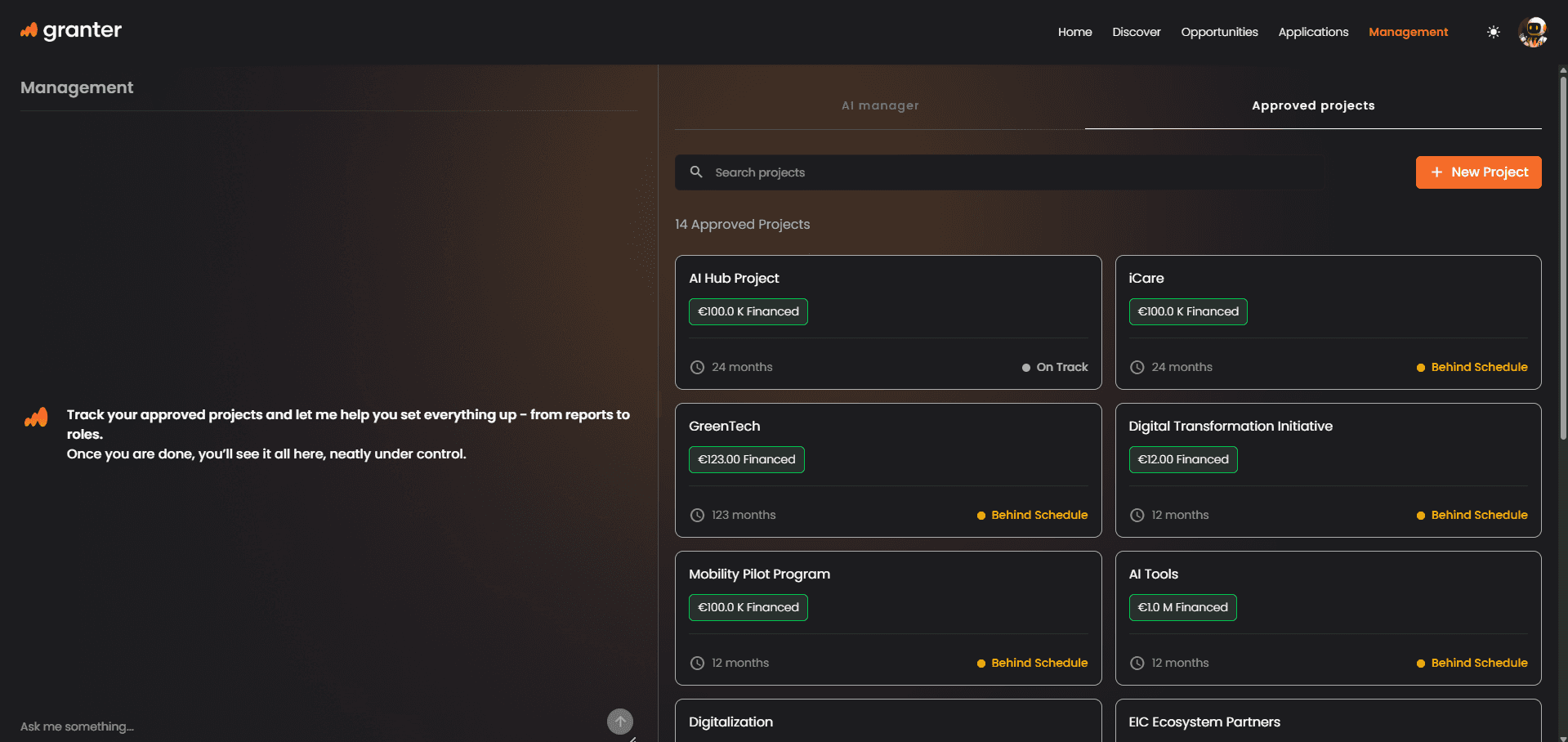
How Granter supports post-approval management
Throughout this guide, we have described how using AI for grant management can help businesses address many of the challenges faced during post-approval. The reporting obligations, the compliance rules, the coordination across partners and the risk of missing deadlines.
Granter was built with all of this in mind. The AI Grant Consultant is an end-to-end platform built for organisations that regularly work with grant funding and are looking for a more efficient way to handle the process.
Unlike tools that focus on a single phase, Granter supports the full grant lifecycle through a suite of AI agents, each designed for a specific part of the process. That means the platform not only uses AI for grant management, but also for opportunity discovery and grant writing.
The Project Management Beta gives organisations an AI-driven environment to run their funded projects from start to finish. After uploading the grant agreement and project files, the AI reads and interprets the deadlines, reporting obligations, and compliance rules specific to that call, translating all required actions into clear, assignable tasks with automatic email reminders to the relevant stakeholders.
When it comes to reporting, teams can generate reports and deliverables directly from existing project information using customizable templates. With the help of a personalized AI agent, users can automatically draft each section of the report, asking for adjustments via direct chat.
As mentioned before, the module is currently in beta, which means there’s still a lot to cover to make this experience even more automated, efficient and complete. To support this development, the feature is already being used by Granter’s clients, whose feedback is shaping future improvements. Other important capabilities for grant management, such as financial and invoice tracking, are among the functionalities coming next.
Winning grants is just the beginning
Of course having your project awarded is already a huge achievement, but the challenge doesn’t stop there. The post-award step can be just as time-consuming as writing the application itself, and the risk of failing is much more costly than before. That’s why companies managing funded projects eventually started to look for better solutions to deal with compliance, stakeholder communication and task organisation.
AI comes into this scenario not as a shortcut that eliminates the work of grant management, but as a tool that reduces the operational overhead so that teams can focus on what actually matters: delivering the project, demonstrating its impact, and building the credibility that makes future funding more likely.
If you are ready to manage your funded projects with a new level of control, clarity and automation, explore how Granter supports the entire grant workflow.
We’re building something powerful. Want in?
Join the waitlist and stay one step ahead in securing innovation funding.